


The thing about this “Tarps Off” baseball trend is that I can’t fully enjoy the camaraderie of it.
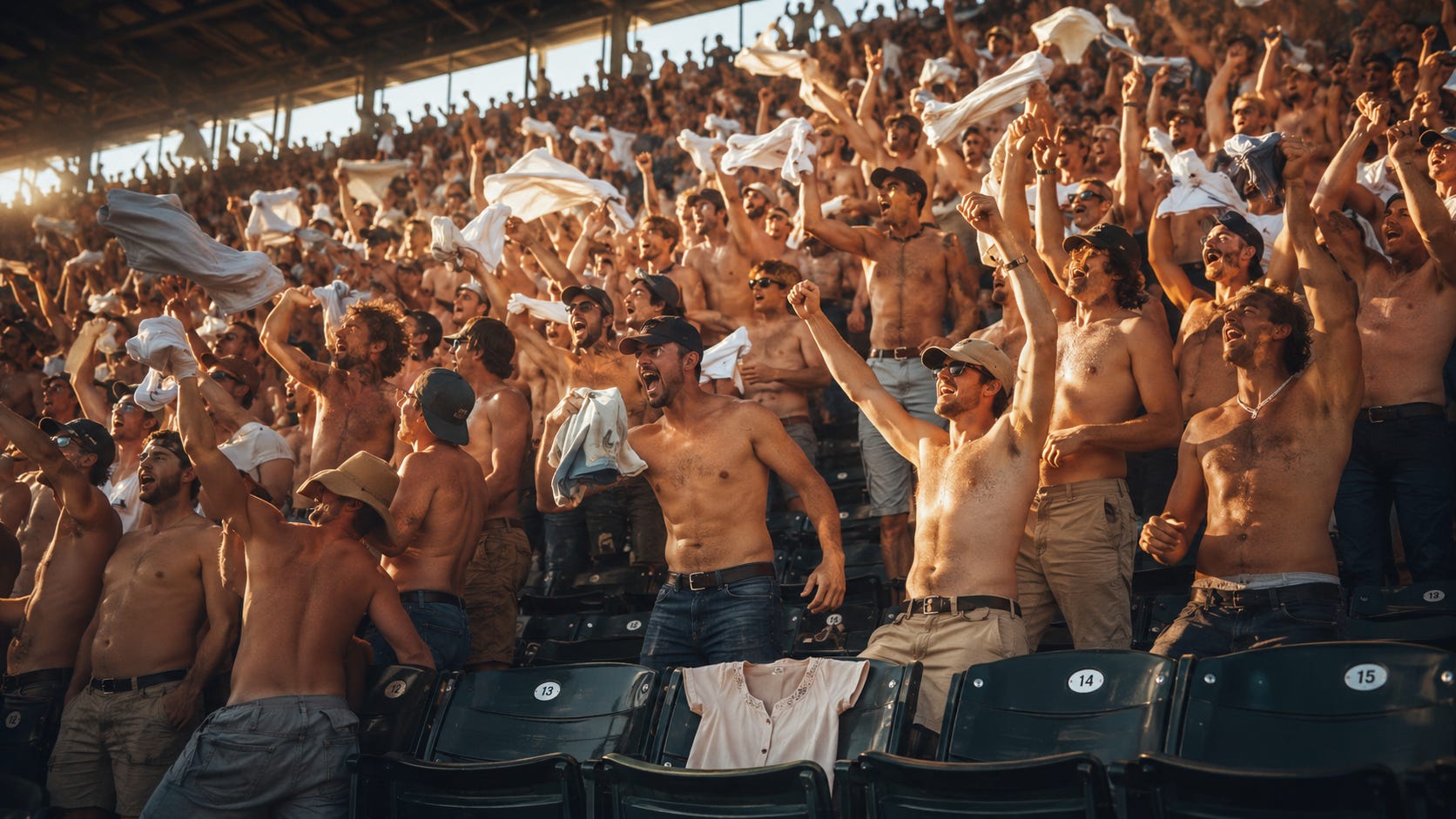
Because all I can think about is this:
As a person with breasts, society would absolutely lose its collective shit if I walked around bare-chested in public.
And before somebody starts hollering about biology, decency, or “appropriateness,” save it.
Men’s chests are not inherently more neutral. Society just decided one version of a torso is harmless and the other is sexual, political, disruptive, tempting, dangerous, or “asking for attention.”
That’s the part that fascinates me.
A stadium full of shirtless men becomes:
community
tradition
team spirit
good clean American fun
A woman existing topless in public?
Suddenly we’re clutching pearls, citing morality, talking about “the children,” and acting like civilization itself is moments from collapse.
And the wild thing is, I don’t even necessarily want to walk around topless.
I just notice freedom when I see it.
I notice who gets to occupy public space casually.
Who gets to be loud.
Who gets to be comfortable in heat.
Who gets to be ridiculous without becoming dangerous.
Who gets to have bodies instead of “statements.”
Because that’s what this really is: casual bodily freedom.
Men get to remove their shirts without their bodies becoming a debate.
Without their morality becoming a referendum.
Without their chest becoming public discourse.
That’s power, whether people recognize it or not.
Gravity Did What Gravity Does
And let’s tell the truth all the way through while we’re here.
I’m not twenty-two.
I’m post-menopausal.
My breasts look like breasts that have lived a life, not breasts trying to win a popularity contest.
They have sustained life.
They have brought pleasure.
They have survived gravity.
They are not defective because they changed.
They are not shameful because they are no longer performing youth.
They are mine.
Men are allowed to age into comfort.
Women are expected to age into invisibility.
And that’s when you really start noticing the rules.
A shirtless older man at a baseball game is “living his best life.”
A shirtless older woman becomes a public discussion.
A warning.
A spectacle.
A joke.
A morality issue.
A meme before she is a person.
Stay in Your Lane
It reminds me of that moment in Dance with Me when the older dancer sees what the younger dancers are doing and says, “I wanna do that too.”
And you can feel the room dismiss her before she even moves.
Not because she lacks desire.
Not because she lacks ability.
But because everyone around her has already decided what kind of body is allowed to want, to move, to try, to be seen.
That is the quieter rule underneath all of this:
stay in your lane.
Age gracefully.
Dress appropriately.
Be respectable.
Do not ask to feel free in public.
Do not remind anyone that your body still belongs to you.
Even now.
Even after motherhood.
Even after menopause.
Even after survival.
Even after the body has carried work, grief, heat, joy, stress, years, and history.
We are still expected to negotiate whether our existence is visually acceptable before we’re allowed comfort.
The Old Brutal Logic
There is an old, brutal logic underneath all of this:
the idea that a woman’s body has an assigned purpose.
Be desirable, but not too available.
Be fertile, but not too loud about the cost.
Be modest, but still pleasing.
Be youthful, but not childish.
Age, but do not become visible in your aging.
And when you are no longer useful within that framework, disappear.
That is the part I keep thinking about.
Not because a shirtless baseball chant is the same thing as historical practices that treated widows as disposable. It is not.
But because the same old question keeps echoing underneath different rules:
What is a woman allowed to be once she is no longer being arranged for someone else’s comfort?
The Children Are Watching
What fascinates me is how early this starts.
When I was little, my chest looked just like my male cousins’ chests.
Flat.
Childish.
No real visible difference.
And yet somehow they were allowed to exist freely in the heat while I was already being taught regulation.
My wife remembers something different.
She grew up in the country, running around outside barefoot and bare-chested as a little kid in the heat, the same way boys did.
Free.
Unselfconscious.
Human.
Meanwhile, I grew up in the city already learning surveillance.
Already learning:
Cover yourself.
Close your legs.
Put a shirt on.
That’s not ladylike.
People are looking.
Don’t give people a reason.
That conditioning starts long before sexuality ever enters the picture.
Which means this was never really about “protecting children.”
The children are learning the rule from us now, in real time.
Boys learn:
Your body is natural.
Your body belongs in the world.
Girls learn:
Your body is public property that must be managed for other people’s comfort.
Your body must be negotiated.
And apparently we’re still teaching that lesson at baseball games now.
That contrast has stayed with me because it proves the rules are not natural.
They are taught.
The Stories We Tell About Bodies
And this is where I keep coming back to the stories we are told about bodies.
Because the story matters.
For generations, even biology was narrated like conquest.
The sperm races.
The sperm wins.
The sperm penetrates.
The egg waits.
Even there, the body coded as female was made passive in the telling.
But what happens when the story changes?
What happens when we admit that bodies are not neutral in the way we describe them, study them, regulate them, or shame them?
That is what I keep seeing in this baseball trend.
Not just shirtless men having fun.
A story.
A story about whose body is allowed to be casual.
Whose body is allowed to be funny.
Whose body is allowed to be hot, sweaty, aging, loud, ridiculous, and free without becoming a public problem.
And whose body has to be justified before it is allowed to exist.
Modesty Is Not the Same as Control
And to be clear, this is not me arguing that everybody should walk around naked.
I’m actually a fairly modest person.
I like structure.
Layers.
Clothing with shape and intention.
I feel more like myself in draped fabric than bodycon anything.
Sometimes I cover my hair because it’s comfortable, grounding, practical, or simply beautiful to me.
But there is a difference between choosing modesty and being taught that your body is inherently disruptive.
There’s a difference between self-respect and surveillance.
Because real self-control has never been about forcing other people to disappear themselves.
It is about how you conduct yourself.
How you behave around other human beings.
How you practice restraint, dignity, and respect without requiring someone else’s body to carry the burden of your discipline.
Closing the Loop
So no, this is not really about whether a bunch of men take their shirts off at a baseball game.
It is about what gets celebrated as freedom when men do it and what gets punished as indecency when women even imagine the same thing.
It is about children watching from the stands and learning, again, who gets to be comfortable in public.
It is about a country that calls baseball America’s pastime while still passing down America’s oldest lessons:
boys get space
girls get rules
And apparently, even in a stadium full of bare chests, some of us are still expected to keep our shirts on.
Thank you for posting this. I am a Cardinals fan and attend a few games a year. I was wrestling with my feelings on Tarps Off and why I'm so uncomfortable with it. You brought clarity. Another thing that bothers me about TO is we're mostly only seeing white guys. Where are Black guys? Personally, I'd like to see it banned. But the MLB is driven by money. They love it. And they're mostly men. There's that.