

Introspection Sunday
Pain as Proof of Worth


Fear as discipline.
We are either taught we have power, or we learn we are powerless. Both require belief. Only one requires submission.
Submission comes in many forms. For children, sometimes submission is all they know—despite the body’s early knowledge that something isn’t right yet.
I’ve been thinking about how early we’re taught what pain is for.
When I was a kid, I sat under a salon dryer with relaxer burning the crown of my head and didn’t say anything. Not because I didn’t feel it—I felt it—but because I believed enduring it quietly was the price of becoming acceptable. Presentable. Worth the result.
I didn’t know the word conformity yet. I only knew that pain, if borne correctly, came with permission — and that refusing it came with consequences.
Side note: I’m not referring here to consensual kink or BDSM, where power and pain are negotiated, chosen, and reversible. Those spaces rely on consent and accountability. What I’m describing is pain reframed as “discipline” when there is no real choice, no exit, and no care.
How pain becomes “discipline”
Pain rarely introduces itself as violence. It arrives dressed as instruction.
We’re told it builds character. That it prepares us and separates those who are serious from those who aren’t. Over time, pain stops being something that happens to us and becomes something we’re expected to cooperate with—something we’re meant to interpret as guidance rather than harm.
This reframing happens early. Children are praised for enduring discomfort quietly. For not making a scene. For being “good.” The message is subtle but consistent: pain is not the problem; resistance is.
Discipline, in this context, isn’t about learning limits or developing skill at all. It’s about training the body to accept correction without protest. The reward isn’t relief—it’s approval. Belonging. Continued access.
What gets lost in this exchange is the original question: Was this pain necessary at all? That question disappears because discipline teaches us to measure success by compliance, not by care. If you endure it properly, the system works. If you don’t, the failure is framed as personal weakness.
Over time, pain becomes proof. Proof that you want it badly enough. Proof that you’re willing to submit to the process. Proof that you deserve whatever comes next.
And once pain is accepted as discipline, discipline can be endlessly expanded. It can move from the body to behavior, from childhood to work, from private spaces to public ones. It becomes a language power uses to justify itself—clean, corrective, unquestioned.
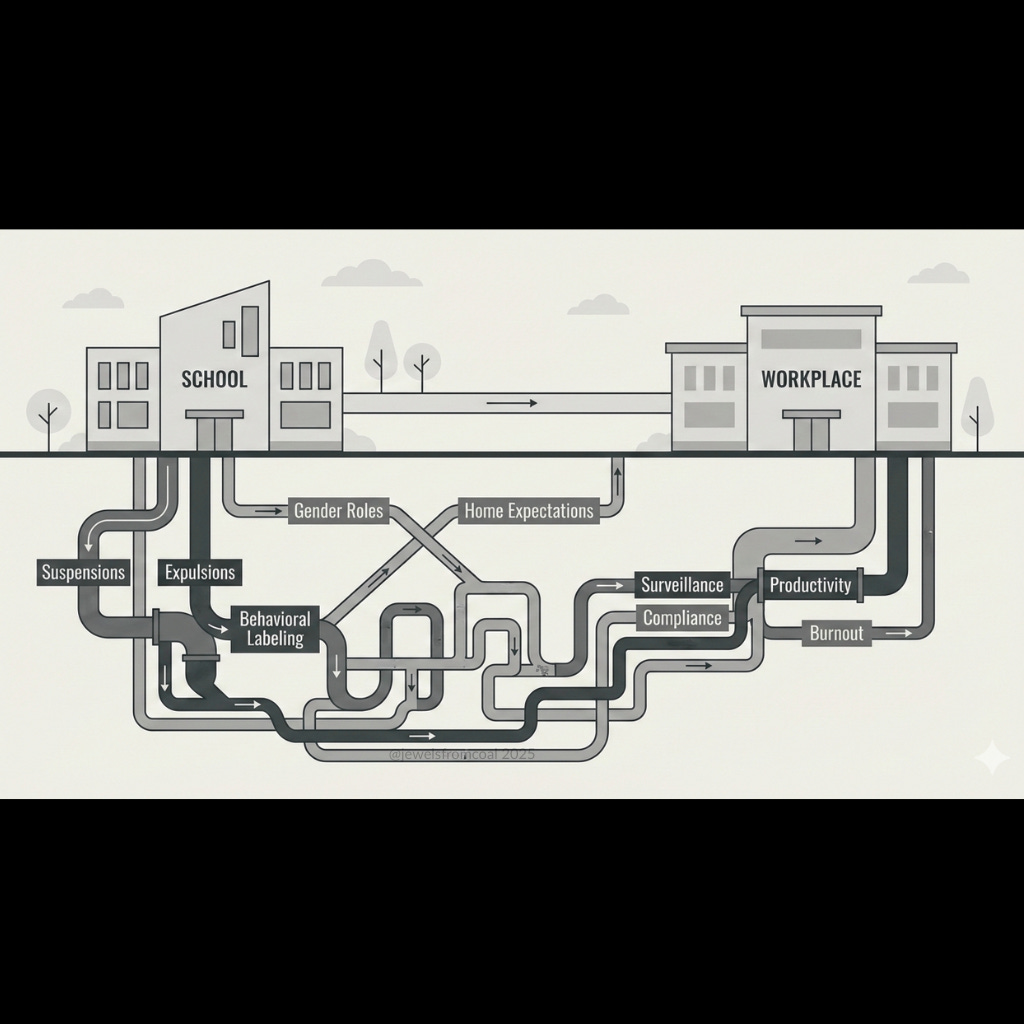
When “Discipline” Pays the Bills
The lessons about pain don’t stay in childhood. They follow us into the places that pay our rent and our medical bills.
In a lot of workplaces, pain gets renamed “commitment.” Staying late becomes “being a team player.” Working through exhaustion becomes “resilience.” Skipping lunch, pushing through headaches, working sick or emotionally flooded becomes “dedication.” The body’s needs do not disappear; they are simply rebranded as inconvenience.
The stakes are different now. As adults, the price of refusal is not a disapproving look from a parent or a teacher. The price is performance reviews, stalled promotions, reputation, income. The fear shifts from “Will they be mad at me?” to “Will I still be able to support myself and the people who depend on me?”
So people push. They work overtime. They answer emails at night. They carry workloads meant for two or three people and are told this is what it means to be “professional.” When the warning signs show up—burnout, irritability, numbness—those, too, are reframed as personal failings. You are told to manage your time better, be more positive, practice self-care on your own time.
In that environment, pain becomes proof again. Proof that you care about your job. Proof that you are serious. Proof that you can be trusted with more. The system reads your willingness to hurt as evidence of your value, while quietly increasing the demand.
This is how discipline gets weaponized: not as a path to skill or mutual respect, but as a way to keep people in line. The body still knows something is wrong. The paycheck is what convinces you to stay anyway.
Once pain is accepted as discipline, it stops needing justification. It becomes background noise. A prerequisite. A test you’re expected to pass without asking who designed it or who benefits when you do.
That logic shows up early, follows us into adulthood, and settles comfortably into institutions that reward endurance more than care. Over time, it teaches us to confuse survival with worthiness, and compliance with strength.
What unsettles me is how often our stories reinforce this lesson—how frequently pain is framed as preparation for leadership, sacrifice as destiny, and silence as maturity. We’re taught to admire those who endure the most without complaint, rarely stopping to ask what that endurance costs, or who is spared it altogether.
I’ve been sitting with one of those stories lately. Watching how pain is used as a filter. How discipline becomes a moral test. How worth gets measured by how much someone is willing to withstand.
I want to look at that more closely.
What happens when the same logic that teaches us to endure pain becomes the measure of leadership?💎
Gosh, it's interesting how you framed that whole "pain as discipline" thing, like it's totally an early-stage algorithm for social compliance. What if it makes us less likely to question bad systams, even as adults?
Hitting close with this one, ouch