

Neurodivergent Gumbo — Frozen: Part II
The Fracture

Round 2 continues, and now that we’ve mapped the childhood blueprint, the story widens.
Part I showed us how silence, secrecy, and inherited fear raised two girls in a palace that never once gave them language for what they were feeling.
Part II shows us what that upbringing created.
Anna grows into a young woman shaped not by whimsy, but by deprivation.
Elsa grows into a queen shaped not by discipline, but by fear.
And the trolls—once healers—resurface as the machinery of heteronormativity, forcing romance into a story about two sisters who were never given the chance to grow up whole.
This section pulls back the curtain on the emotional mechanics of Frozen:
the hunger, the masking, the desperate attachment, the way Disney reframes trauma responses as personality traits.
If Part I told us what happened,
Part II tells us what it did to them.
Anna’s Attachment Hunger
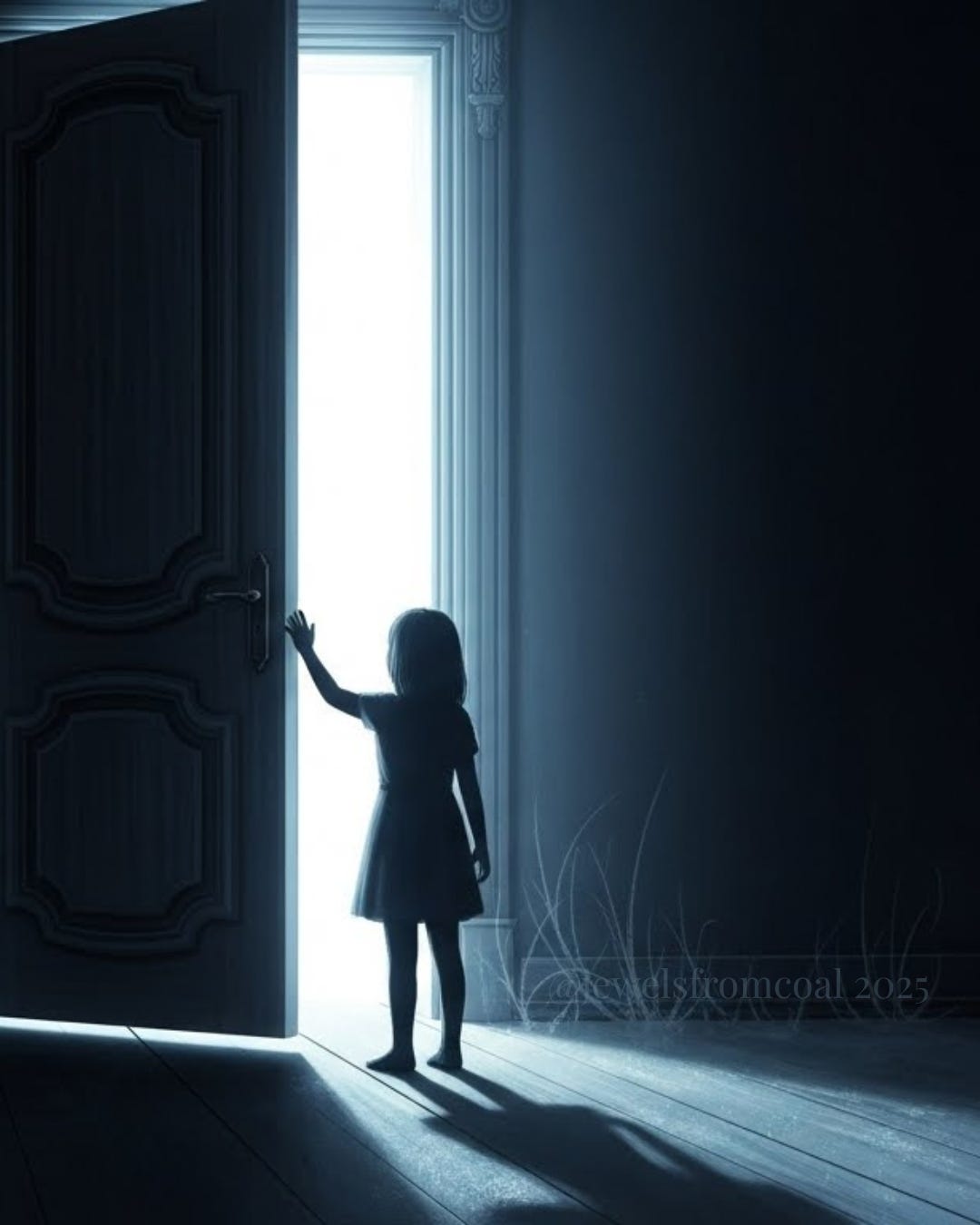
If Elsa grows up shaped by fear, Anna grows up shaped by absence. Her childhood doesn’t fracture in a single dramatic moment the way Elsa’s does; it erodes slowly, quietly, in the long shadow of unanswered questions. Anna is not given the truth about the accident, and children who don’t get truth create their own logic. In her mind, Elsa’s withdrawal becomes a mystery she interprets as rejection. The silence becomes abandonment. The distance becomes a puzzle she is too young to solve but too loyal to ignore.
The film treats Anna’s optimism as her defining trait, but optimism born from deprivation is not hope—it’s survival. When she sings on coronation day about possibility and excitement, she is not yearning for adventure; she is desperate for connection. Years of knocking on a door that never opened conditioned her to chase closeness wherever she thinks she might find it. The song people remember as whimsical is, underneath, the soundtrack of a child who never stopped wanting something she could not name.
Anna doesn’t talk about loneliness because she has no language for it. She only knows how it feels in her body: the restlessness, the impulse to attach quickly, the joy that spikes too fast and the disappointment that follows just as sharply. Disney frames this as endearing naïveté, but the emotional patterns are plain. Anna is starving. And when you are starving, you reach for whatever looks like food.
This is why Hans lands so easily. He is the first person in years who pays her focused attention. He mirrors her excitement. He answers her questions. He doesn’t retreat. To a girl who has lived in emotional quarantine, that isn’t romance—it’s relief. The film positions her attachment as foolish, but it isn’t foolishness; it’s what happens when childhood isolation becomes adulthood longing. She mistakes recognition for love because she has never had enough of either to understand the difference.
Her pursuit of Elsa later in the film is framed as courage, but it carries the same imprint. Elsa was her first attachment, even if that attachment was severed without warning. Anna isn’t only chasing her sister because she loves her; she’s chasing the only relationship that once made her feel seen. She is trying to return to the last moment she remembers being whole. The trek through the snow feels heroic on the surface, but underneath, it is the old ache of childhood trying to repair itself.
And when Olaf tells her that Kristoff “loves” her, she accepts it instantly. Not because the evidence is convincing, but because the idea itself is a salve. Kristoff shows her kindness, patience, presence—qualities she’s had so little practice receiving that she interprets them as something larger, something fated. The film uses this moment to reinforce Disney’s favorite promise: that true love is always waiting in the wings. But Anna’s acceptance isn’t about destiny. It’s about deprivation.
Nothing about Anna’s emotional landscape is whimsical. It is shaped by a childhood with no peers, no shared memories, no open communication, and no dependable affection. It is shaped by a palace full of doors that never opened. The film asks us to root for her romantic arc, but what she truly needs is connection that isn’t contingent, love that isn’t transactional, and companionship that isn’t framed as the solution to a wound no one ever helped her understand.
Anna is not foolish. She is unmothered. Unmentored. Unexplained. A girl taught to keep reaching long after her hand should have been taken.
Her hunger is not a flaw.
It is the predictable outcome of a childhood where longing went unanswered.
Elsa the Masker

Where Anna responds to the family’s silence with hunger, Elsa responds with containment. She becomes the daughter who learns early that existing openly is a risk. After the accident, she isn’t given language, context, or comfort—she’s given rules. Gloves. Distance. Mantras that sound protective but operate like commands: conceal, don’t feel, don’t let it show. The palace becomes less a home and more a training ground for self-erasure.
Because the truth is simple: Elsa isn’t taught to manage her emotions. She’s taught to fear them.
Every time she startles, the adults stiffen. Every time she expresses discomfort, they retreat. Every time she asks a question, the answer is avoidance. Over time, she internalizes the idea that her emotions are dangerous to others—that safety requires silence, and love requires distance. She grows up believing that closeness is a luxury she cannot afford.
The world mistakes this for composure. But Elsa’s composure is not maturity. It’s masking.
Masking is the art of appearing controlled while chaos churns beneath the surface. It’s the coping mechanism of someone who has learned that their true self frightens the people they rely on. Elsa doesn’t become quiet because she is introverted; she becomes quiet because she is terrified. Every breath, every gesture, every movement is calculated to minimize the possibility of harm.
By the time her coronation arrives, she is a master of handled emotion—polished on the outside, panicked on the inside. The tension in her body is visible in every frame. She flinches when touched. She hesitates before speaking. She avoids eye contact. It’s not fear of ruling; it’s fear of being seen.
And when the mask cracks, it cracks entirely. The freezing of the ballroom isn’t a loss of control—it’s the inevitable outcome of a child who was never taught how to hold her own feelings safely. The moment the gloves come off, both literally and metaphorically, her entire internal world erupts in the only language it has: ice.
The film frames her escape into the mountains as liberation, but liberation without support is just another form of isolation. The ice palace is beautiful, yes—geometric, crystalline, breathtaking. But it is also a fortress built by someone who believes she cannot exist in the world without hurting it. She finds freedom only by removing herself. Her empowerment is conditional: she can be herself, but only alone.
Disney sells this moment as self-acceptance, but what it really shows is a girl who believes the safest way to live is to disappear.
Elsa’s struggle isn’t about magic. It’s about surviving a childhood where fear dictated every decision, where emotional honesty was treated like a threat, and where her difference was framed as a burden rather than a birthright. Her power never frightened her—other people’s reactions did. Their fear taught her to fear herself.
Her isolation is not a flaw in her character—it is the logical outcome of a world that gave her no other path.
The Trolls and the Machinery of Heteronormativity
When Anna and Kristoff arrive at the troll valley, the film wants the moment to feel playful—an unexpected detour filled with singing, dancing, and comic confusion. But beneath the humor, the scene exposes two of Disney’s most persistent habits: treating crisis as an opportunity for romance, and treating young women’s distress as a backdrop for matchmaking.
Anna is dying.
Kristoff is panicked.
Time is running out.
And the trolls respond as though this is a meet-cute.
Instead of addressing Anna’s condition with urgency, they swarm Kristoff with questions about his “girlfriend,” projecting domestic fantasies onto a relationship that barely exists. Their song reframes Anna’s desperate situation into an extended joke about how imperfect men need “fixing”—a trope that trivializes both Anna’s crisis and Kristoff’s genuine concern. The tension becomes a punchline, and the near-death experience becomes a vehicle for reinforcing the idea that every male-female pairing must be nudged toward romance.
What makes the moment even stranger is how easily the trolls slide between roles. In the childhood sequence, they are healers and sages, protectors of memory and guides for the frightened. In this scene, they become matchmakers with suspiciously detailed opinions about human courtship. The film treats this shift as whimsy, but it reveals something more deliberate: Disney’s inability to imagine care that isn’t romantic, and wisdom that isn’t also a push toward coupling.
Even Olaf participates unintentionally. When he tells Anna that Kristoff “loves” her, he isn’t offering insight—he’s voicing the narrative logic the movie is built on. In the universe of Frozen, kindness equals love, concern equals destiny, and the first man who stands beside you in a storm must have been placed there by fate. The trolls don’t initiate this pattern; they amplify what the story already expects the viewer to accept.
What Anna needs in that moment is clear information and emotional grounding. What she receives instead is a lesson in heteronormative inevitability: the assumption that her crisis is significant primarily because of the romantic possibilities it might unlock. Her emotional deprivation is never acknowledged; her desperation for connection is never named. Instead, the scene treats her attachment wounds as comedic fodder, smoothing over the seriousness of her condition with a narrative shortcut Disney has relied on for generations.
The trolls’ song insists that the biggest problem in the room is a romantic misunderstanding, when the truth is that the only real misunderstanding is the one the story refuses to address: Anna does not need a love interest—she needs care that isn’t transactional, affection that isn’t destiny, and a community that sees her beyond the role of future partner.
But Disney doesn’t know how to build that world.
So instead it builds a musical number.💎
Now that we’ve traced Anna’s hunger, Elsa’s containment, and the trolls’ narrative interference, the storm is finally taking shape.
Part II revealed that nothing about these sisters is magical — it’s all emotional physics.
Trauma, deprivation, masking, longing… these are the forces that drive the plot far more than ice or destiny ever could.
But the world of Frozen is bigger than the girls who survived it.
Part III widens the lens again — into the machinery behind the magic.
We’ll talk about retcon, revisionist storytelling, and how Disney smooths over harm by rewriting history instead of confronting it. We’ll examine the uncanny familiarity of fairy-tale indoctrination and what it means to raise entire generations on the idea that systems don’t have to change — only children do.
The ice is cracking now.
Next, we see what lies beneath it.